
1st September 2026: The MR Heads for Swansea, Part 3: Colbren Jnc to Swansea - Chris Jones
Our branch secretary Chris Jones returned to start the new season, continuing the story of the Midland Railway's journey to Swansea over a steep and winding road. In this part 3 we started at Colbren Junction, went down to Neath, back up again down to the junction with the Swansea Vale Railway at Ynysygeinon Junction, over to Brynamman East and all the way down to our final destination at Swansea St Thomas station.
The presentation was the usual mix of photos and maps. The photos were from various acknowledged sources including Michael Roach, WAC Camwell, Michael Hale (courtesy of The GW Society), Alan Jarvis and Jack Boskett, all loaned for use. There were even a few of the speakers!
Colbren to Neath was the territory of The Neath and Brecon Railway and opened in 1863 when passenger trains started to run (unofficially!). The line served the collieries of the Dulais Valley and fertile farmland to the North on its way to Brecon. One of the maps showed the short-lived cooperation with the LNWR promoting a link with the N and B line and The Central Wales line at Llangammach Wells in 1870. This came to nothing. An opening shot featured the Valley Wanderer Rail tour of April 1965 as Chris apologised for a mostly unending run of pannier tanks. Colbren for some reason had a Saxby and Farmer SB. The only one.
South of Colbren was the route to Neath. Steeply graded in places with 9 stops and by the 1960’s there was only one daily through train to Brecon mostly in the dark during the winter. A few trains ran to and from Colbren. At Onllwyn there was a change from panniers as “Austerities” were seen working the extensive colliery system. All open cast working ceased in March 2022 and Jack Boskett was on hand to record the passing of the last train of coal. Further down the line a brief visit to Severn Sisters featured local entrepreneur Colonel Bevan and a mysterious wedding present from him to the speakers parents!
The line had become very weedy and neglected by the end to passengers in October 1962. Neath believe it or not at one time had 4 stations, one even was a short lived (1865 to 1877) halt on the SWR main line above Neath Riverside then known as Low level. Chris had tried to find Canal side station but gave up in the tangle of scrub.
Back to Colbren and then we travelled down the “Swansea Vale and Neath and Brecon Junction Railway” This provided the vital connection about 6 steep miles for MR trains to get to Swansea and opened in 1868.
The Swansea Vale line was taken over by the MR in 1871 and wholly about 1884. An early shot showed a snowy scene with “Johnson South Wales” tank engine.
From Brynamman East the line ran down to Swansea and a visit was made and a look round the locality yesterday and today. Including a shot of Brynamman West which closed in 1958. Brynamman East closed to passengers in 1950. Chris covered to line down the valley some 18mls to Swansea. The stations were a mix of wood and stone with the latter in the minority. There were two sheds at Gurnos and Upper Bank and both were covered. The line opened in stages with construction beginning in 1855 and final opening to Brynamman in 1868.
At Pontardawe in addition to a Midland 1F and a “Jinty” a shot of a famous resident was included - Mary Hopkin!
The stations down to Swansea were included as the line became more industrial. At The terminus Swansea StThomas the buildings were bleak with very little protection from South Wales rain.
Here was our final shot of 2235 a Johnson 0-4-4T on what might have been a through train to Birmingham in the lines heyday as a through route. A few final photos of the dock area finished an interesting evening. The branch thanked the speaker for a valuable contribution to railway history. (CHJ)
7th July 2026: The Role of the Railway Engineering Institution - Joss Apps
Joss works for what until recently was The Permanent Way Institution (PWI) but has recently become, by vote of its membership, the Railway Engineering Institution. This will enable its modernisation and its ability to become more inclusive especially as young people, the entrepreneurs of tomorrow are a bit hazy with the meaning of the “Permanent Way” (PW).
He began training at Nottingham University as a mechanical engineer but partly there because of his other great love of rowing on the nearby Trent. He worked at Hawker Siddeley’s Brush works and the Rover group for a while then changed to railway PW engineering, principally in track work such as turnouts and pointed crossings. In 1994 he joined the PWI and is now employed by its successor body, the Railway Engineering Institution.
There is a whole network around Track/earthworks/drainage and electrification equipment and it was good to listen to a professional on his topic and its many repercussions on supporting a successful railway fit for all variables particularly at the moment on CWR and issues of high summer temperatures and their impact on the PW. We also heard about cuttings and embankments good or bad and sometimes sources of accidents following drainage or inappropriate material being used.
The PWI we learned was set up from a 1884 meeting of a group of PW Inspectors with their first meeting at the Granby Hotel in Nottingham (located adjacent to the Nottingham railway station). From this beginning the Institution has grown in importance and in supporting best practice. A journal was published which carries on today and Joss pays a part in editing it. Numerous publications are also available and he brought a collection to show us. One described all you need to know about track infrastructure including materials/tools/fastening and rail type. Another weighty tome talked about the use of Bull head rail still widely used today.
Something amazing was the variety of topics and detail coming from the RailEI website (https://www.railei.org/). Its contribution to ensuring high standards and inclusion in the rail industry is amazing and all are recommended to dive in and investigate the site with content currently available to all and not just the 4,500 members. Joss covered the main current themes in his thorough talk. That is Digital AI/Electrification and Plant /Track/Earthworks and Water management. There are local groups with programmes of meetings and lectures on line and face to face on various diverse topics. New entrants are well catered for. High standards are supported as well as extensive CPD via lectures and courses leading to professional qualifications. Our railway is in better shape as a result of all this. Heritage lines are often used for teaching and learning practical track work as this sort of activity is no longer available on the national system.
The talk was followed up with some questions and answers on topics such as broken rails now down to single figures per year. Overhead wire issues and increasing weight of rolling stock especially batteries!
Our excellent speaker was warmly thanked by the audience and it is always good to hear about what is happening on our railway (before he left a little early to catch a train).
Bryan Cross then rounded the evening off with some Scottish steam from 1949 to 1950 part of the superb Peter Bland collection all well detailed complete with maps and detailed itinerary. Thank you Bryan for stepping in. (CHJ)
2nd June 2026: Growing up on the Bedford to Bletchley Line - Sean Devany
Our speaker was local man Sean Devaney, whose family were crossing keepers at Kempston Hardwick located on the Bedford to Bletchley line just south of the town. I say all as they all seemed to be involved in the operation of the crossing. The substantial house they lived in was featured right alongside the Bletchley platform. He began by describing how his family arrived there and that his farther as a tailor found the time to carry on as did many workers on the line with sidelines as was usual in those days being the 1970’s. There were descriptions of local working and the operation of the gates and signalling plus even the Cabin diagram though of course the levers were outside. Work was virtually 24hr and at night a bell would ring to go out and unlock the crossing for road users.
There was a brickworks over the road with a canteen to use. Chimneys too as there were legion in the Marston Vale area and so tall chimneys appeared in many of the photos. Sean soon seemed to get on with a career in the railway visiting local signal boxes and even getting to work them at quite an early age. Local was the theme of the evening and we didn’t move more than a few miles for the talk. Travelling down the Bletchley route to Stewartby and then over to the Midland railway main line for a look at long lost SB’s over there
South on Kempston Hardwick was Stewartby, but before that the Wooton Broadmead level crossing which in one of many anecdotes, Sean described the use of awkward Anett’s keys to lock and unlock the gates and in all weathers. His memories of rail operations in the area painted a broad canvas of interesting observations and humorous incidents all described without notes.
The operation in the 1970’s of the new “Fletliner” brick trains was recounted with much detail of loco and crew workings from Stewartby to the north at Garstang and south at one stage to Kings Cross, with the trains being worked by class 25 locos. Thousands, maybe millions, of bricks were efficiently delivered in the is way until the service ceased for road haulage in 1985 and the rundown of brick making.
Nearby Forder’s siding box was shown as overseeing the Stewartby operations. Sean also worked this box which included a stacked set of discs 5 high nearby
Other traffic from the colour era in the 1980’s were the “Western” hauled stone trains and a 08 going off to shunt the brickworks sidings at Stewartby as part of a very complex operation.
Northward to Bedford St Johns and the unfortunate burning down of St John’s number one ex LNWR box shown as a burnt-out skeleton.
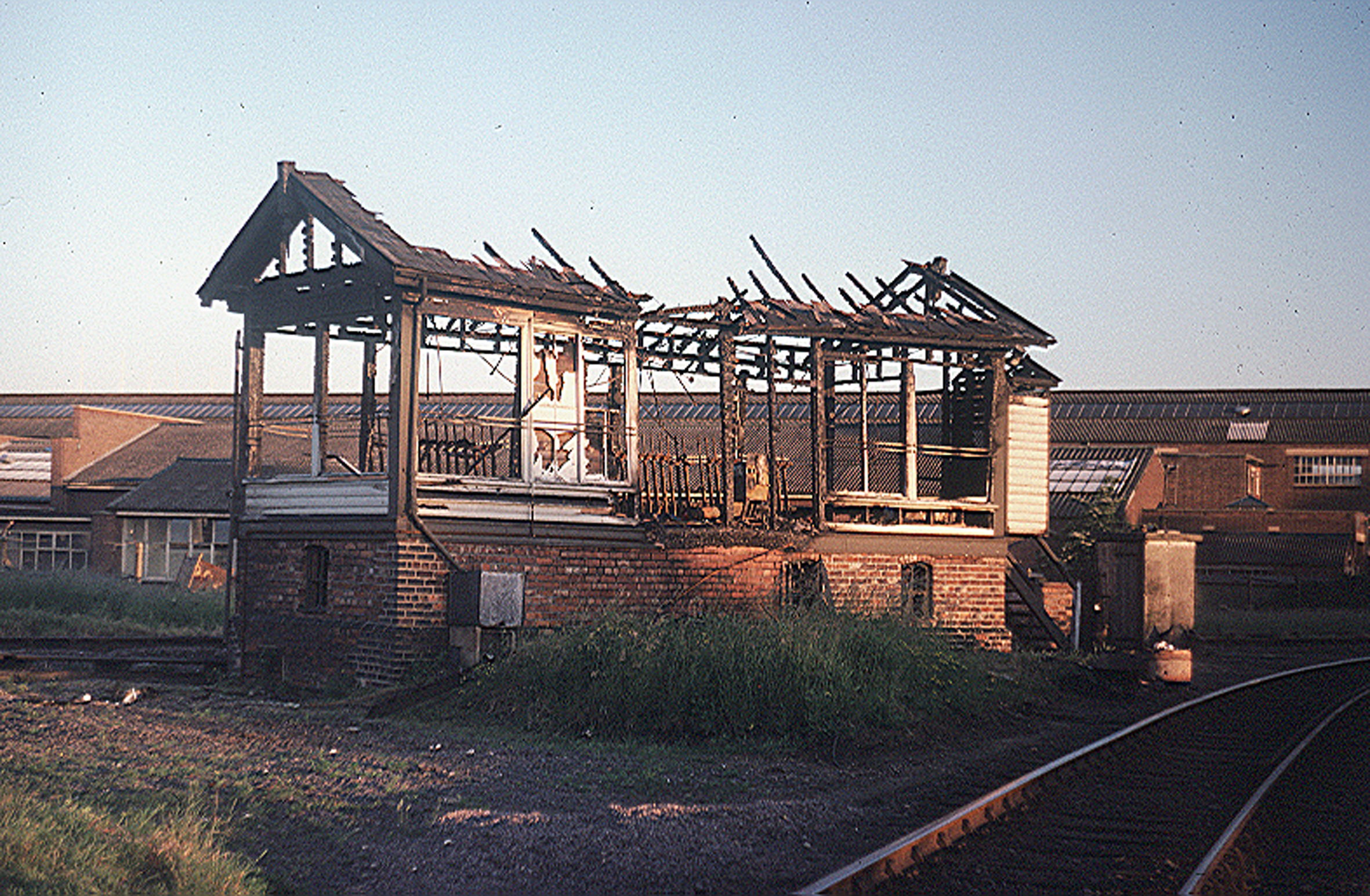
The remains of Bedford St Johns Box after fire, 3rd July 1977. Image: Sean Devaney
Over on the Midland main line we spent time at Houghton Conquest and Millbrook boxes, both active in the 1980s. Sean explained their operation and showed the diagram for HC box and that both boxes had no electricity or running water, which had to be delivered.
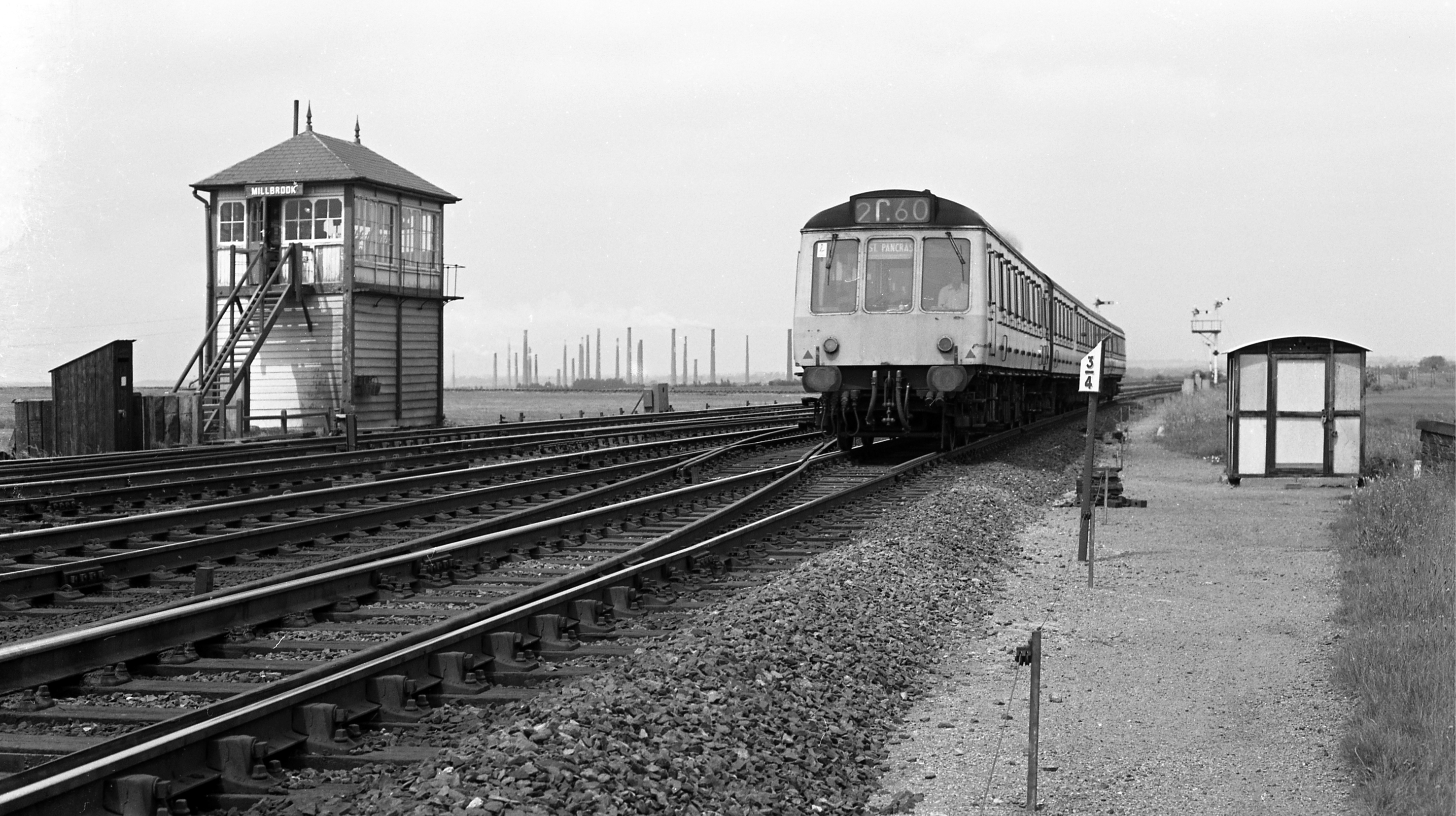
A class 127 dmu on a Bedford - St Pancras working passes Millbrook Signal Box, 20/6/1974, with characteristic brickwork chimneys in the backkground. Image: Bryan Cross
This was a most entertaining talk full of talk of railwaymen and incidents delivered with good humour. From an era long passed and full of various technical details of rail operations and the people involved. How to not go very far but cover much ground with good clear photographs thrown in. Attendees also joined in with extra information of their own
A perfect night on a very local topic. Thank you Sean (CHJ)
5th May 2026: 60 Years of the Settle & Carlisle - Michael Smyth
Michael has spent over 50 years documenting the Settle and Carlisle line in all seasons, and as he said, they can often happen in one day. Dividing the decades and starting on the early 60’s he used a splendid selection of his own photos bar one. This collection meant trekking up and down slopes getting cold and wet and looking out for amazing locations to get stunning images often from some distance showing the spectacular landscape or close up on the lineside, something he said was becoming increasingly difficult due to tree growth.
In the 60’s the first decade to be covered. The first photo depicted the now listed grade one Ribblehead viaduct a classic of steam one of many on the same location from this stunning evening of great photography.
The line was still carrying long distance freight and passenger workings all with steam power which of course ended with the last specials in 1968 before the steam ban came in. Before that the Leeds Stud of Jubilees were seen on Saturday workings and lastly with Alberta seen down the line at Shipley. Then Oliver Cromwell on the famous 15 guinea special also shown later in the day heading south LE. Then the steam ban.
The 70’s was about running down with removal of long-distance services like Thames Clyde substituted with Leeds to Carlise workings only. While the West coast electrification was taking place the removal of catch pints led to the diversion of loose coupled good workings diverted over the S and C. Michael had done his research well and gave us many details of line working arrangements. As this decade progressed wayside stations were closed and Signal Boxes taken out. However, the line was visited by steam specials after 1974 when the steam ban was listed so we saw Scotsman on an early steam special. Freight from quarries generally ended and other freight also vanished. All in a rush towards the expected closure. However, the quality of the photos continued at a brilliant level showing again the stunning landscapes and scenery. Not forgetting the Appleby milk and the Eric Treacy memorial both at Appleby. Two Black 5’s looked spectacular on a “run past”.
In the 80’s steam specials continued and crowds turned out to be added to Michael’s photos. Dent produced many brilliant shots especially 34092 on The Cumbrian Mountain Pullman. More mundane were Cl31’s on Leeds trains of three coaches. Closure notices in the 80, s and more running down but great photos of steam specials ad a tribute to Bernard Staithe and the SLOA. Signal Boxes looked tatty and stations neglected. Some parcel traffic still operated. Colour was coming in more and added to the feast of quality material. All the time the settings were stunning and well photographed. “Dalesrail” added at weekends to the traffic as the line began to revive in the decade and was saved in 1989.
In the 90’s sprinters but more steam specials running and well captured on film. Blue Peter was seen after restoration on its first run. In 1997 coal trains reappeared and IBS had to be introduced where sections had got too long. There was more freight seen in the photos and the line was improved with metal sleepers. A classic shot of 46115 at Blea moor definitely a favourite. As we moved beyond the 2000’s the coal stopped but we saw log traffic instead. Even Tornado working some regular specials, but the Skipton diesel workings were not a success and taken off. In 2016 the line had to close for a year due to a landslide. The location continues to grow in popularity with crowded trains and restored now listed stations and boxes, even the water tower at Settle is now a home! Blue pullman and Sir Nigel also added to the mix.
The evening was a stunning contribution to railway photography, and the final steam trail picture really summed it all up. Many thanks awarded to Michael from a grateful branch meeting.
7th April 2026: Didcot to Birmingham Snow Hill - Images from The Tommy Tomalin Collection, presented by Brian Sullivan
Tommy Tomalin was a great character, given to visiting the same locations over many years, so we were treated to regular steam in the early 60’s. Steam in its dying days and on special trains. Then a variety of diesel traction with the photos often taken in similar settings sometimes involving climbing structures like overbridges and church towers. Tommy also attended the settings in all weathers particularly in the snow when he ventured across fields for a better distant view. The talk was accompanied by clear maps so the route north could be easily followed.
We began at Didcot with a view of the pre-electrification station noting that it had not changed a great deal. Then through Culham with its attractive Brunelian building, to Radley seen in 1966:another station still open despite others closing.
The outside of Abingdon looked attractive and was one of a number where Tommy got up very early to photograph the outside of a station in a suitable light. He lived in Northampton! In those pre internet days he managed to be there for the passing of steam specials sometimes long delayed as well. The whole presentation was a tour over a scenic country route covering a variety of traction taken over a 50 year period.
The halts round Oxford were covered with an early whiskered DMU turning up. Also, Pendennis Castle on a 1965 special to add to the many special working we saw on the line. Steam again at Kidlington, with a Hall heading south.
Tommy shinned up a church tower for a shot of a cl47 on an Ealing to Blackpool working. There was much steam around Banbury including a brief shed visit. Class 50’s showed up. We learned that Heyford station building went to the GW Soc and at Aynho the station is still a restaurant. At Aynho snow featured as well as a shot from a bridge girder. Sir Nigel Gresley was seen on a special working in Feb 1985. The LCGB ran two Gresley Commemorative tours, but we were told about the delays, but Tommy was still there with his camera. Kings Sutton minus buildings mostly now but a good study of a 9F on a freight seen from the remains of the Chipping Norton Line. Locally Clun Castle was being used for freight and was seen in another great shot. Fenny Compton featured an 8F and a 9F both on freight.
Unusual to see a Western but one was on a “King” special and it was D1038 Western Sovereign. This combination at Leamington Spa along with photos of a Mince Pie special with a Pannier. Tommy often came out on weekdays so captured Didcot coal workings in the 1980’s.
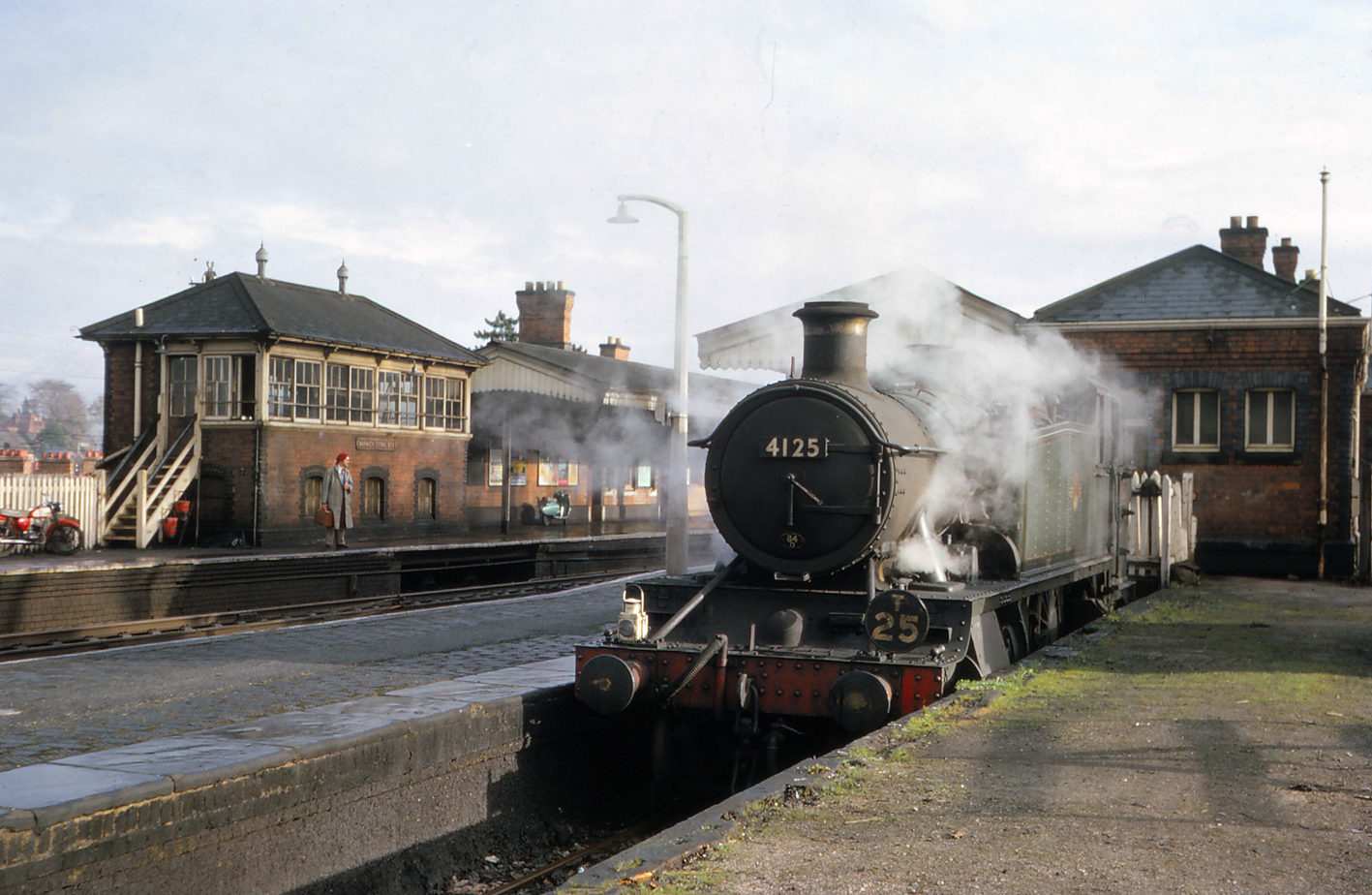
Ex-GWR 2-6-2T 4125 in the bay at Warwick Station, ready for banking if required, Saturday 24/11/62. Image: the late Tommy Tomalin
Then moving on to Warwick with Hatton bankers to be seen. As a Bonus Scotsman came by on a special first time after preservation. Then Sir Nigel again at Dorridge. As we approached Birmingham the urban stations were visited along with an Ivatt and Pannier hauled set of specials to commemorate the closure of Moor Street Station, later reopened and improved.
Journeys end was an atmospheric shot at Snow Hill. The branch thanked Brian for All his work on the topic and slide scanning of Tommy's collection.
3rd March 2026: The Last Years of Steam around North Wales -.Michael Clemens
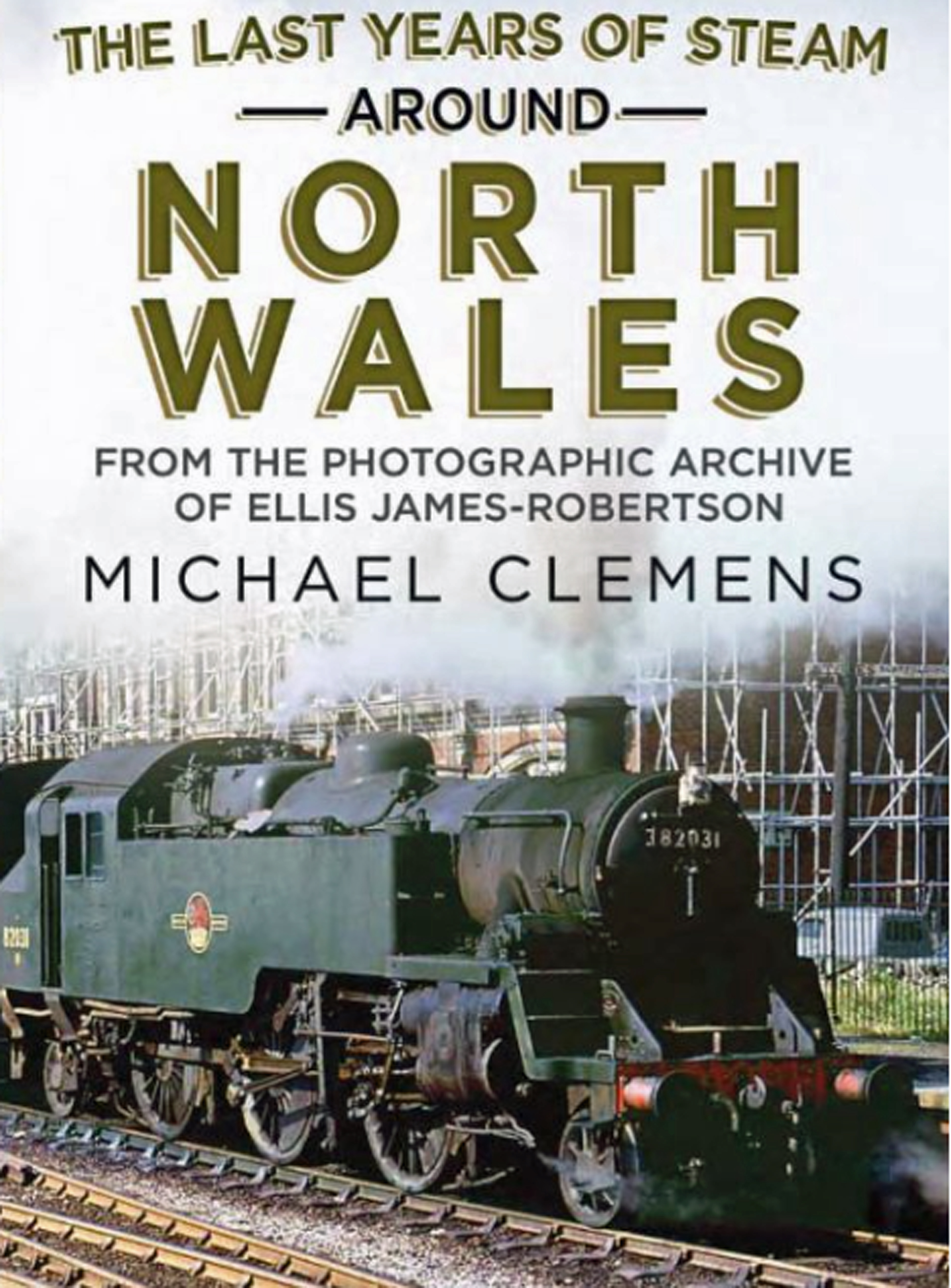
The extensive tour covered many parts of North and Mid Wales, using both his father Jim’s pictures and those of the late R E James-Robertson, of which Michael is the custodian. We are indebted to Michael for time and effort he puts in one enhancing where needed film and slides to give us such a good presentation. His website also makes a major contribution to the researching of railway history..
Starting briefly at Amlwch and Llanfair PG with its unique old wagon turntable we moved onto the Carnarvon to Afon Wen line with some quality material. At Bangor we saw train and shed scenes expertly recorded by Mr James-Robertson, who it seemed had a superior camera but new how to compose pictures. Bangor was always a difficult place to photograph being hemmed in by hills, but the pictures did full justice to the site in the early 60’s. We saw Brits and Royal Scots all splendidly turned out.
We moved down the coast via the Llanberis branch then only open to specials and freight. Then past Dinas Junction and up to Nantle where BR was using some of its last horses for shunting and working some slate traffic. At Afon when there was a great deal of Butlins traffic to photograph in stunning detail where we noted that the photographs Michael was showing that enlarging them maintained the stunning quality.
At Porthmadog Jim Clemens had been there to record the early stirrings of the FR across the Cob, something I just remember. Then on down the coast towards Harlech and that view from the castle. Jim had ventured up Britain's one-time steepest street with its 20-degree incline in Harlech, very scary. Via the last train to Blaenau Festiniog from Bala and off to Corwen. Michael pointed out along the way that he had been coached in Welsh pronunciation, which shows just how polished he is. I learned a bit myself to improve my presentations. On up the Tanat Valley and local lines with the last Dukedog lying at Machynlleth. At Aberystwyth we stopped to turn north again and head inland for Welshpool where again we were treated to some lively shots as the WLLR threaded its terminal way through the back streets
Slate followed with visits to the Padarn system and those amazing Hunslet infused quarries at Dinorwic and including the end at the port. Wow never seen anything as good considering the age of the material
In part two we were treated to film of the Barmouth to Ruabon line. Some more quarry visits all again in superb restored colour and finally the last train from Gloucester via Ross to the cable works near Lydbrook Junction. Oh, those carefree days of hopping on and off and the security of an ex-GWR Toad brake van.
A great evening was had by all. Thank you, Michael again (CHJ)
3rd February 2026: The Nidd Valley Railway - Tony Manktelow
The lead in by Tony was the excellent scenery, great walking and good places to stay all in magnificent scenery. His talk covered the standard gauge NER Branch running up the Nidd Valley to Pateley Bridge, the Nidd Valley Light Railway from Its own though connected station running on to Lofthouse and finally the contractors line running up to the reservoir construction sites at the top of the valley
Firstly, Tony paid tribute to Tommy Tomalin by producing A Tomalin style map of the locations
The NER branch ran through attractive countryside mostly bordering the River Nidd with well-built attractive vernacular stations which featured in the photographs each having a distinctive gable end. The line passed through lightly populated countryside so was never going to attract the needed sustainable volume of passenger traffic so opened in 1862 it was closed to passengers in 1951 but freight lingered on until 1964. The terminus at Pateley Bridge is another substantial and surviving building though now with a road in front.
A line went over the road and connected to the lesser-known Nidd Valley Light Railway. A 6.5 mile line owned and operated by Bradford Corporation and opened in 1907 to serve the upper part of the valley and also the extension which ran eventually to two reservoirs
This line also served an extensive quarry system up the hill via a very steep cable worked incline with photos to prove it. It was rather special stone which ended up in many parts of the UK by rail of course and closing in 1915
The town terminus was strongly built and well-engineered and came with some interesting coaches and motive power all well researched by our excellent speaker. Of note were the ex-Met coaches all looking good and well painted and an ex GWR steam railcar no 15. What a treat it all looked to ride on and enjoy the scenery all for a very few short years to only 1929!
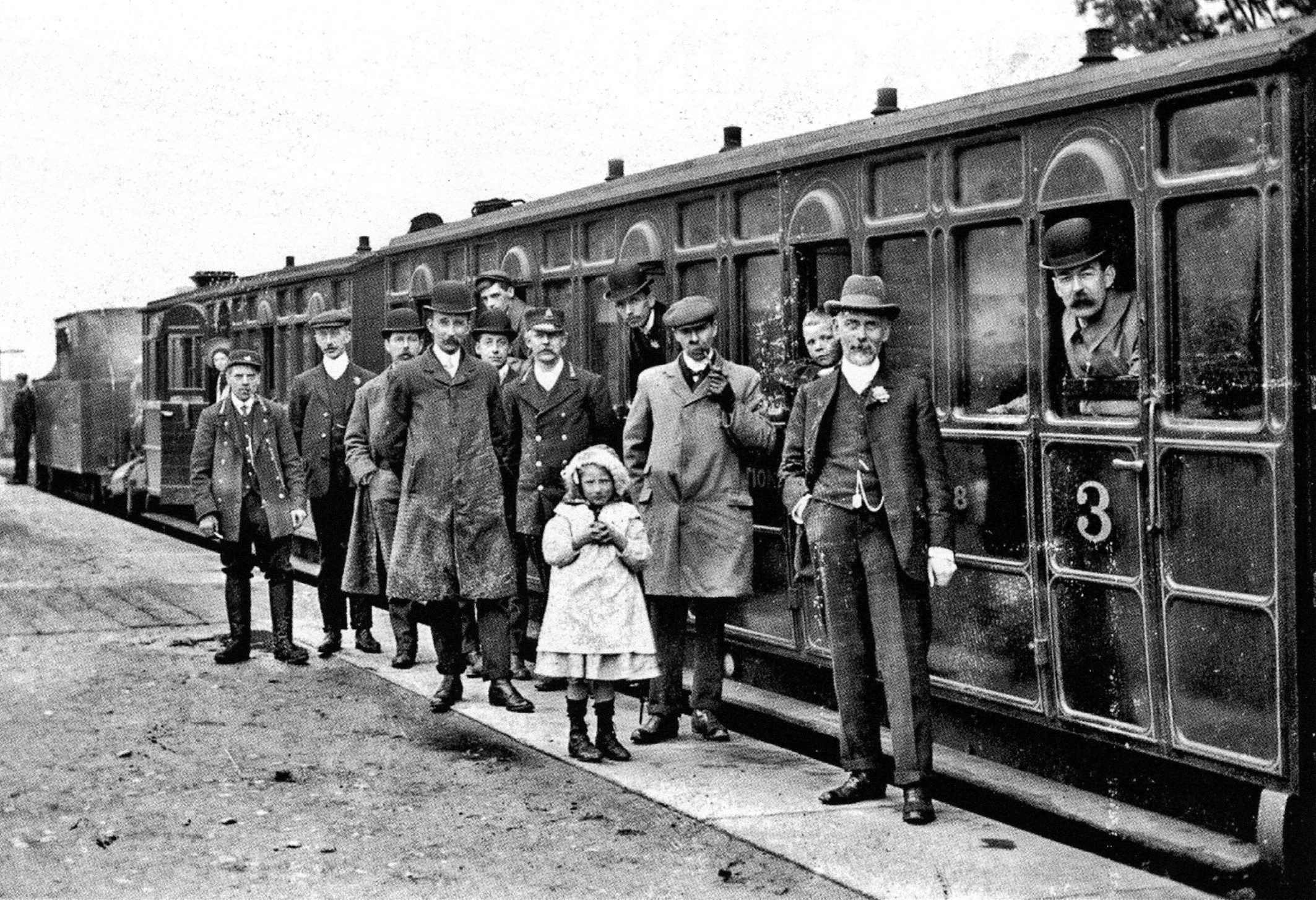
A Nidd Valley Light Railway train, formed of an ex Metropolitan Rly locomotive and carriages, at Lofthouse-in-Nidderdale, c1920. Image: Tony Manktelow collection
Stations were solid with goods yard and loops and long lasting especially Wath which the speaker would love to acquire.
The line had many locomotives often named after Bradford mayors.
Beyond the end of the passenger line at Lofthouse was the steep route to the reservoirs with a surviving but bricked up tunnel. There were some amazing pictures of traffic on the reservoir branch which even had some passenger coaches ex Maryport and Carlisle railway for workers use
We all enjoyed this look at one of Britain’s minor railways a great night and very thorough indeed. A big thanks from the Branch to Tony
6th January 2026: Ashford to Hastings Revisited - Richard Crane
The speaker to start our new year off on 6th January was none other than our regular member and old friend Richard Crane, who seems to leave no stone unturned in his tour of Britain visiting lines not often talked about and he then delivers a thorough analysis to entertain us with good photos and research. This time his chosen subject was the Ashford to Hastings line, with a branch down to Dungeness.
Our journey began at Ashford opened in 1842 after two years of construction. Richard regarded Ashford as the main centre with its works and steam shed. Electrification not arriving until 1961 so there was much steam variety to be seen in a multitude of great pictures especially of handsome “Nelsons”. There were “Z” and blocky “Q’s” all on magnificent display. The nearby works opened in 1847 and built its first locomotive in 1853. It at one time employed 1300 men. The whole place was a great spotters centre. Diesels arrived later as did “The Ashford International Station” a white elephant of a place so little cared for that Richard was marched off when he tried to photograph its entrance hall
Now off down the line behind an ”H” cl or a later cl 171 in its new shininess. Via Ham Street to Appledore with its surviving attractive building. Then a diversion to Dungeness imagined in its flat sky looking landscape. Sand seemed to be everywhere as we approached the sea and no doubt blew into axle boxes and carriages alike. A nuclear landscape still provided some traffic but the nearby RH&DR was shown in all its delicate diminutive glory.
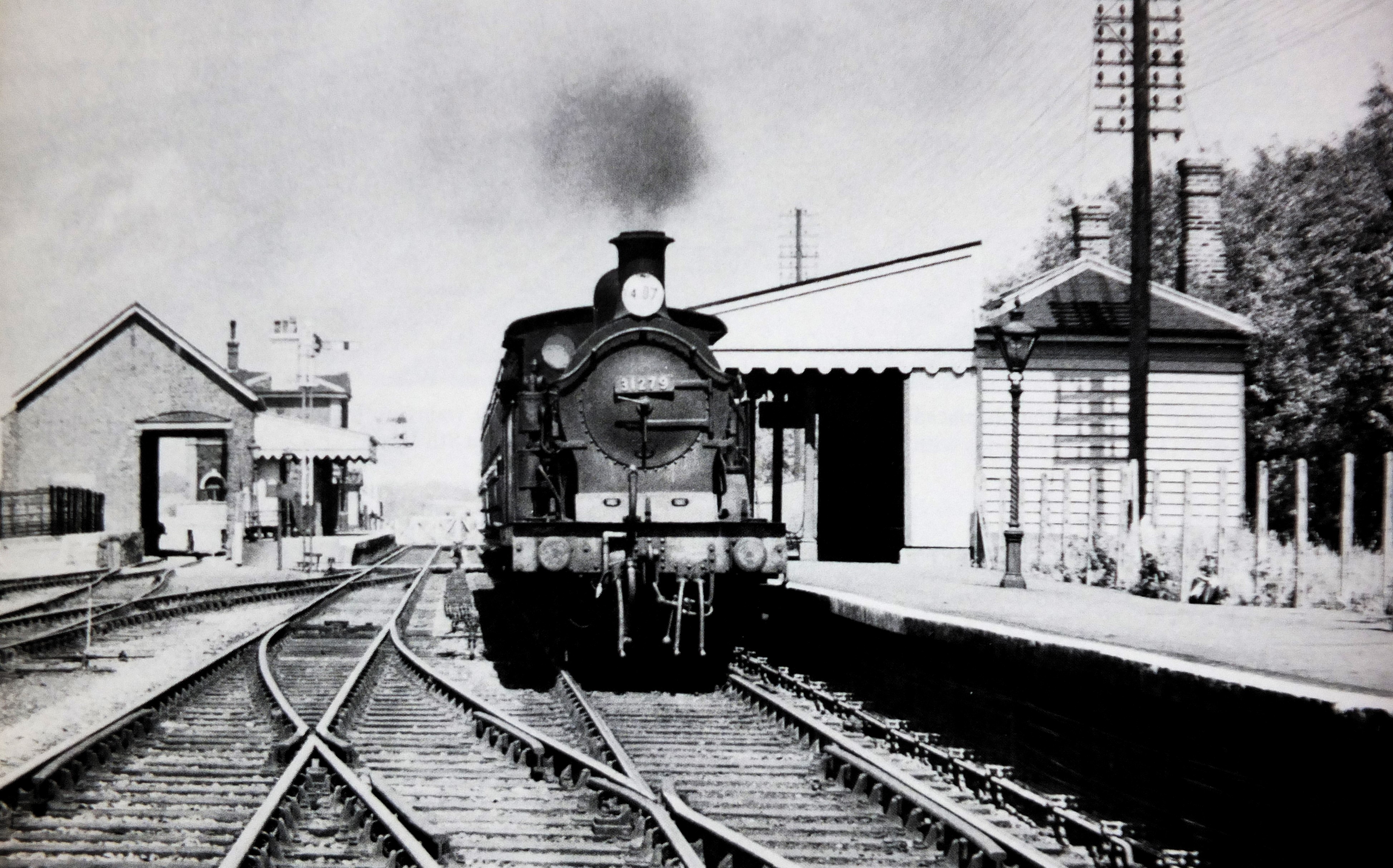
Ex SECR H class 0-4-4T No. 31279 at Appledore with a train for New Romney train in 1958. Image: Richard Crane collection.
Back up the branch and now away like the wind and through the inevitable enveloping trees towards Rye and its satisfying town and little toy line to Camber now only a memory. We were pleased to see a Bedford Built Simplex going about its historic business.
Rye box though seemingly without a frame has survived to work local level crossings and recently been restored to the correct livery and lives on before its bushy backdrop. Nearby Richard advised us to try the good station cafe
The harbour branch was not forgotten before we moved past the iconic windmill and bridge to continue our happy journey towards the dreamy Hastings. Beyond Winchelsea other stations were added presumably to cater for new developments like Snailham closed in 1959 with Doleham and Three Oaks however still operating and seen in DMU ears and then third rail traction starting at Ore quite near to Hastings
On through the tunnel past impressive overbridges t arrive in the station. Richard had unearthed some fine pictures both old and new and informed us that the mechanical signals and box had recently been restored with illustrations. He was not so pleased with the newer station façade slightly to the east of the old station since demolished.
To show what to see locally Richard had visited the Hastings NG railway and looked at the Cliff railway
Thus, there is plenty to see, enjoy and learn on this route from Ashford. Richard will no doubt be recalled by the branch for another dip in the box of UK unusual railway locations. Thanks, from us all. (CHJ)